


Getting this together was tricky. I don’t have physical access to most of these dictionaries and had a hard time finding entries in other languages. So, I used the Windows Snippet tool a few times. Apologies if it looks jagged. And without further ado…

In this West, we know that cup of brown magic as coffee. It wakes us up in the morning and keeps us going throughout the day, how many of us have been late to work because the line at Dunkin’ or Starbucks was too long? Coffee has many ways it can be ordered and many ways it can be referenced. I believe that this cup can be a unifying factor for people across all cultures. But first, what do we call it?
Coffee is the fuel of America. Merriam-Webster states that coffee ([ˈkȯ-fē]) states that it was in 1598 where English-speaking people understood the term as “a beverage made by percolation, infusion, or decoction from the roasted and ground seeds of a coffee plant.” Over the last few hundred years, we have come to take a liking to coffee. For example, New Yorkers consume seven times more coffee than residents of any other city in the United States. The cup is pretty much as American as apple pie. Seattle is home to Starbucks. The Bay Area has a strong coffee culture. I will need another post to list out more.
Where the word coffee comes from exactly is difficult to say. Dictionary.com and Merriam-Webster say that the word comes from the Italian caffé. The Online Etymology Dictionary expands this origin to German kaffee and French, café. Taken from Oxford Languages via Google, the German kaffee is explained as such.
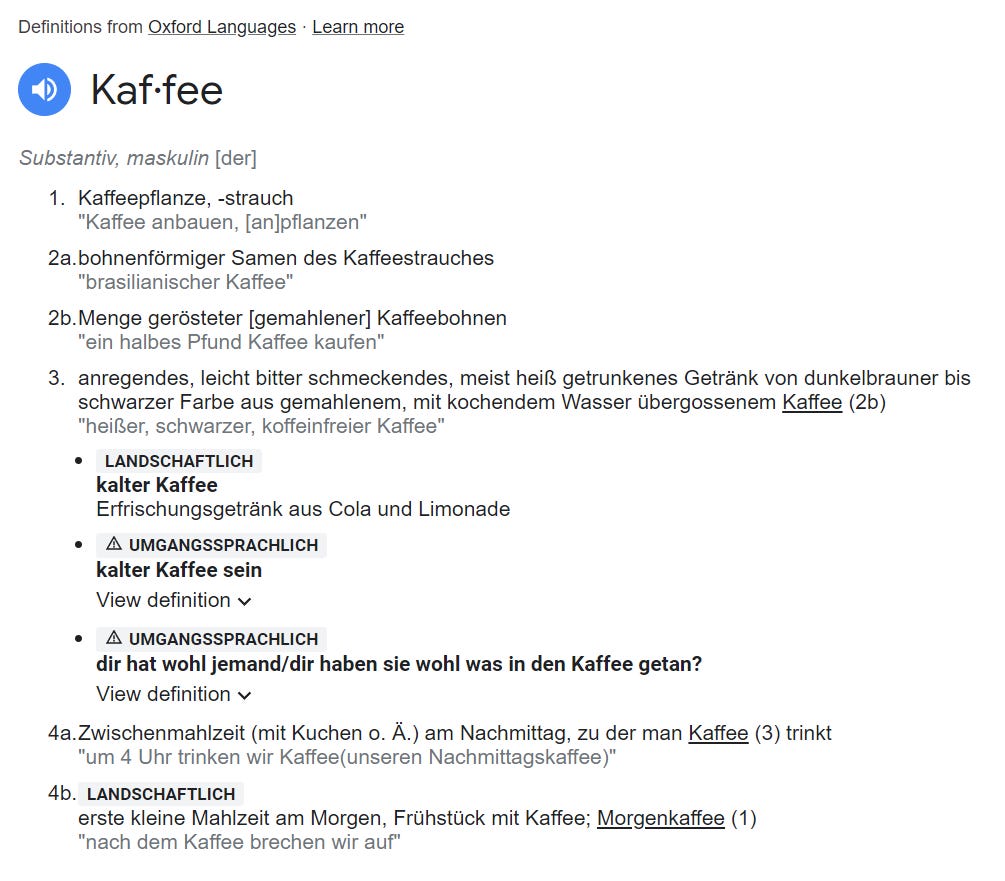
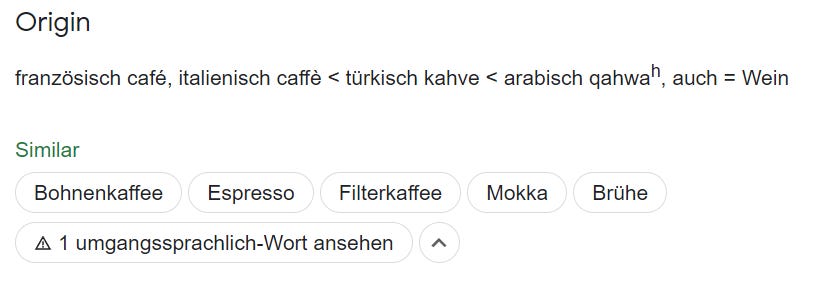
Definition 2a, “bean-shaped seed of the coffee” is the one I highlight.
Taken from Oxford Languages via Google, the Italian caffé is understood as such:
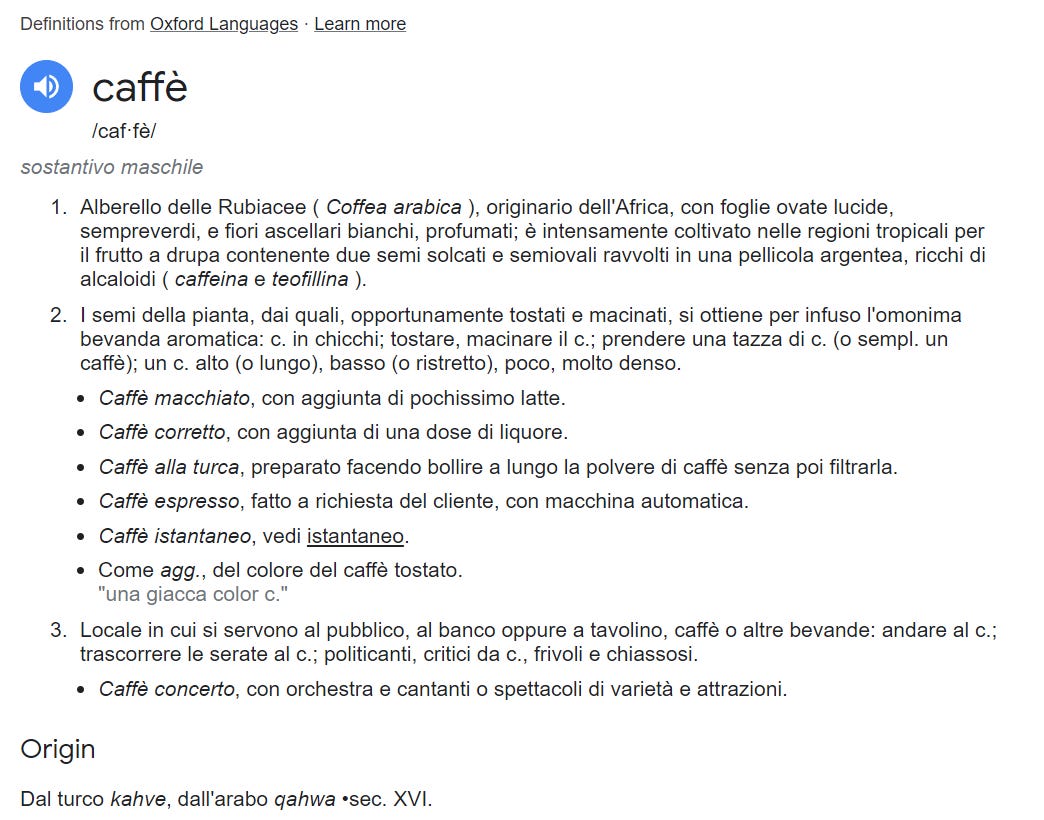
In Italian, the definition is more precise. The first definition speaks about a Rubiaceae tree, native to Africa. It describes the tree as one with shiny, evergreen, ovate leaves with white, scented axillary flowers. The closer you get to qahwa, the closer you get to the origin. Like many things, Europe becomes the bridge of culture from the East to the United States. At one point we commercialized the drink for better or worse. I need my coffee and I need it now. But in Europe, it is drunk as a wind-down for the day.
There is one more stop before we get to the Arabic. If Yemen and Ethiopia are the homes of coffee, then Istanbul is the door. In Turkish, the word for coffee is kahve. This drink is so important that breakfast, kahvaltı, means the meal you have in the morning before kahve. Taken from Türk Dil Kurumu, kahve is defined as,
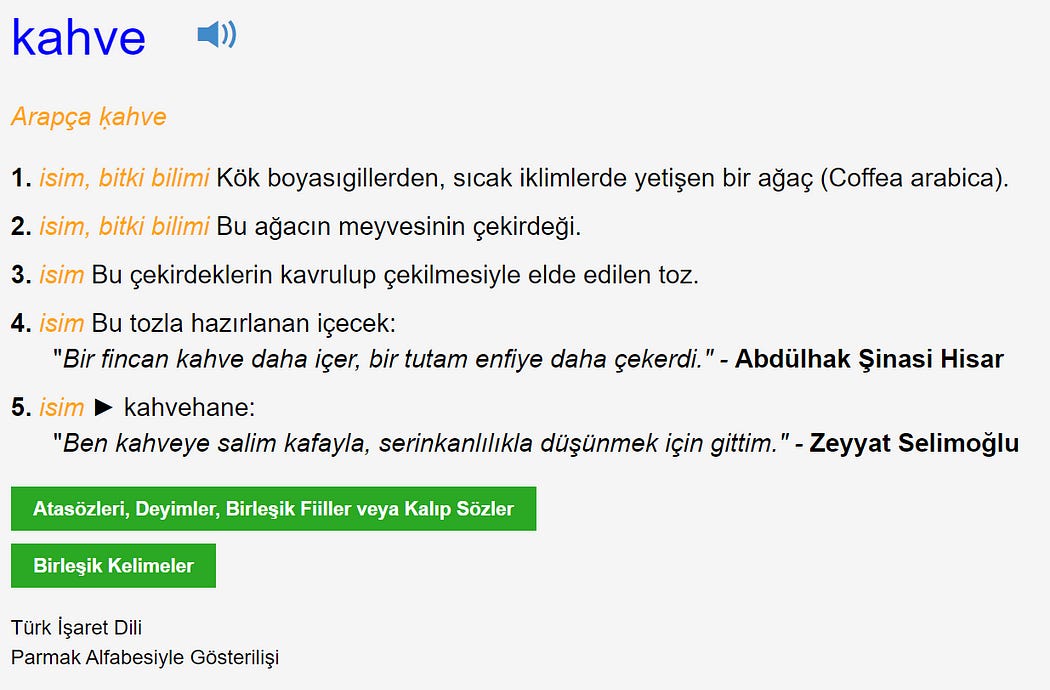
The first two definitions speak of coffee to the last drop: “a tree from the rhubarb family that grows in hot climates” and “the seed of the fruit of this tree.” The language used is very precise.
Which leads me to the Arabic, qahwa. I must take a tangent. In this process of putting this together, I learned another word for coffee, bunn. This translates to coffee beans, (unground) coffee.

Qahwa the word is coffee brewed.


Arabic is a language based on root letters. With that comes a wide range of definitions that comes from three letters. Lane’s Lexicon goes into even more detail.
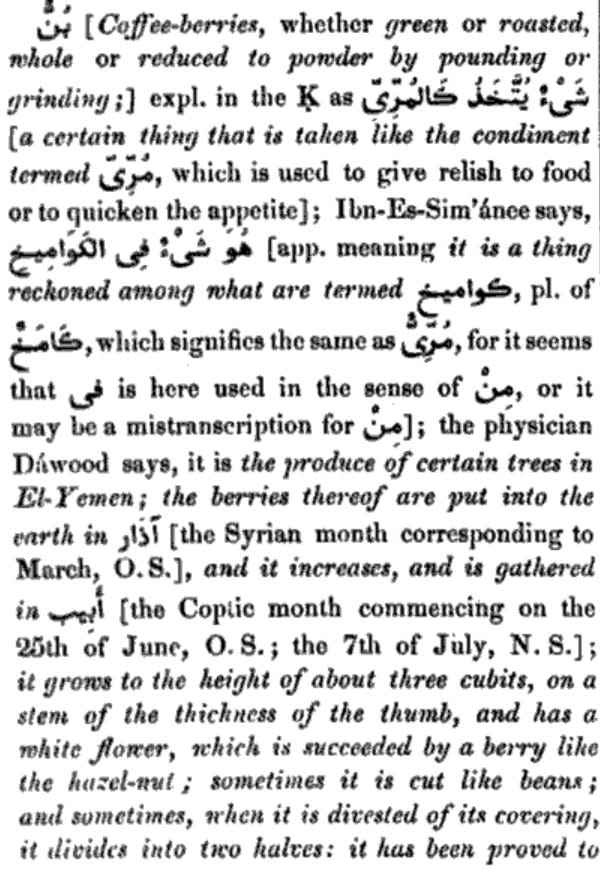
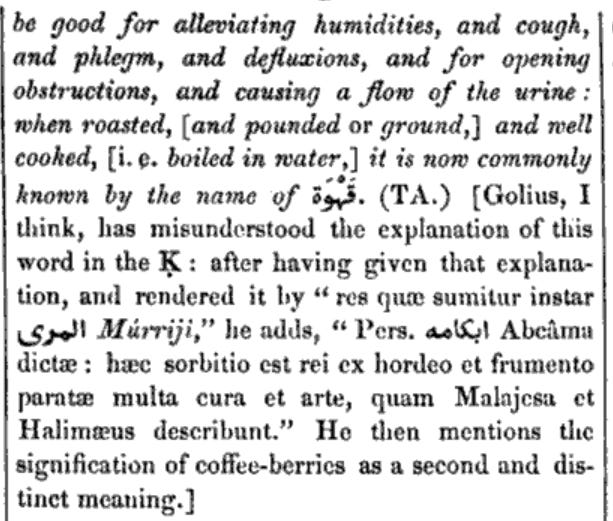
Lane references other works and includes the history of bunn in his entry. The entry is fascinating and has a lot to unpack.
This one cup has many names: coffee, café, kaffee, kahve, and qahwa. It has captivated the world for hundreds of years. We stand in line for it. We invest in equipment to brew it at home. There are YouTube channels dedicated to it. It is expressed in various ways, all going back to that seed found within. What can you do with that seed within you? Are you berry-like like an Ethiopian? Are you earthy like the bean from Sumatra? Fruity like Central or South America? Coffee is a way to cultivate and express that. Get to grinding and brewing.